
A pharmacy, a dental practice, a pet shop: when an existing building is rebuilt while the business keeps running, the preparation decides whether both work out in the end, the conversion and daily trade. We build from our base in Wildau within a radius of around 50 kilometres and have carried out conversions in open shops, active workshops and occupied buildings.
The difference from a new build lies in everything around it. Customer traffic, deliveries, opening hours and escape routes stay in place, and the site works around them. What that looks like in practice depends on the trade. A pharmacy with strict hygiene requirements in the dispensary sets different conditions than a pet shop with live animals.
Adapting the site setup to local conditions
Before the first wall comes down, we settle the routes. Where do customers walk, where is material delivered, where does the escape route stay clear. For a conversion in an occupied building the site is set up so that customer and construction traffic stay separate, often via a fixed dust protection wall and a dedicated access route for materials.
We plan deliveries around the busy periods. In a retail unit that means bringing material in before opening or during the midday lull, so the sales floor stays free at peak times. The binding construction schedule we draw up for every project sets these windows from the outset.
Dust protection and when it stops paying off
Dust is the most common problem when converting an existing building. For separation we use dust protection walls, material airlocks and, in sensitive areas, negative pressure with class H dust extractors, so the dust never reaches the area in operation.
Beyond a certain point this effort no longer pays off. If a whole section of the building is being taken out of use for the conversion anyway, an elaborate dust airlock costs more than it delivers. In that case we seal the area off roughly and completely rather than running a fine containment that nobody needs. We make this call on site, because it depends on the floor area, the use and the build time.
Noisy work outside business hours
Some work cannot be reconciled with live customer traffic. Core drilling through a reinforced concrete slab or cutting concrete with a diamond saw produces noise and vibration that are not bearable in a practice or a shop. We schedule such work in the fringe hours.
| Work | Why it is critical | Time window |
|---|---|---|
| Core drilling | noise, vibration, drilling water | before opening or after closing |
| Diamond cutting of concrete | sustained high noise, cutting water | outside business hours |
| Demolition and chasing | noise, dust, vibration | fringe hours, in sections |
| Screed, drywall, painting | quiet, little disturbance | possible during operation |
Order and cleanliness in visible areas
Wherever customers walk past, the site is part of the impression the business makes. So we keep the visible transitions clean, clad the dust protection walls neatly and clear away tools and material at the end of the day. The business should keep running without customers feeling they are walking through a construction site.
The sequence of trades is part of this too. We work in sections, so that only one part of the floor is taken up at a time and the rest stays clean and usable. After each section we clean up before the next begins, so that dust and rubble do not build up across the whole construction period.
Structural interventions and load transfers
Many conversions change the load-bearing structure. A new opening in a load-bearing wall or the removal of a column calls for a load transfer, usually via steel beams that take up the load before the masonry is opened. The structural calculation is done beforehand, and we coordinate the sequence so that the area in operation is never left under an unsecured opening.
With our own engineers, certified foremen and concrete workers we have carried out these interventions for more than 25 years. Precisely this work, demolition and shell construction within an existing building, makes the difference between a conversion that shuts the business down and one that lets it keep running. You can find an overview of our range under Services.
Fire safety during the construction phase
During a conversion, walls are opened, slabs are drilled through and services are rerouted. Every penetration through a fire compartment has to be sealed again properly, so that fire and smoke cannot travel through the new opening in an emergency. Maerkische Projekt Bau is a certified specialist for firestopping and restores fire compartments and escape routes after every construction phase.
This is decisive with the business open, because people are inside the building while the work goes on. An open cable seal above the dispensary or a blocked escape route is a real risk in a shop with public traffic. How we interlock fire safety, drywall and fit-out is described on our Service page.
How we solved it at the Berlin Workshops
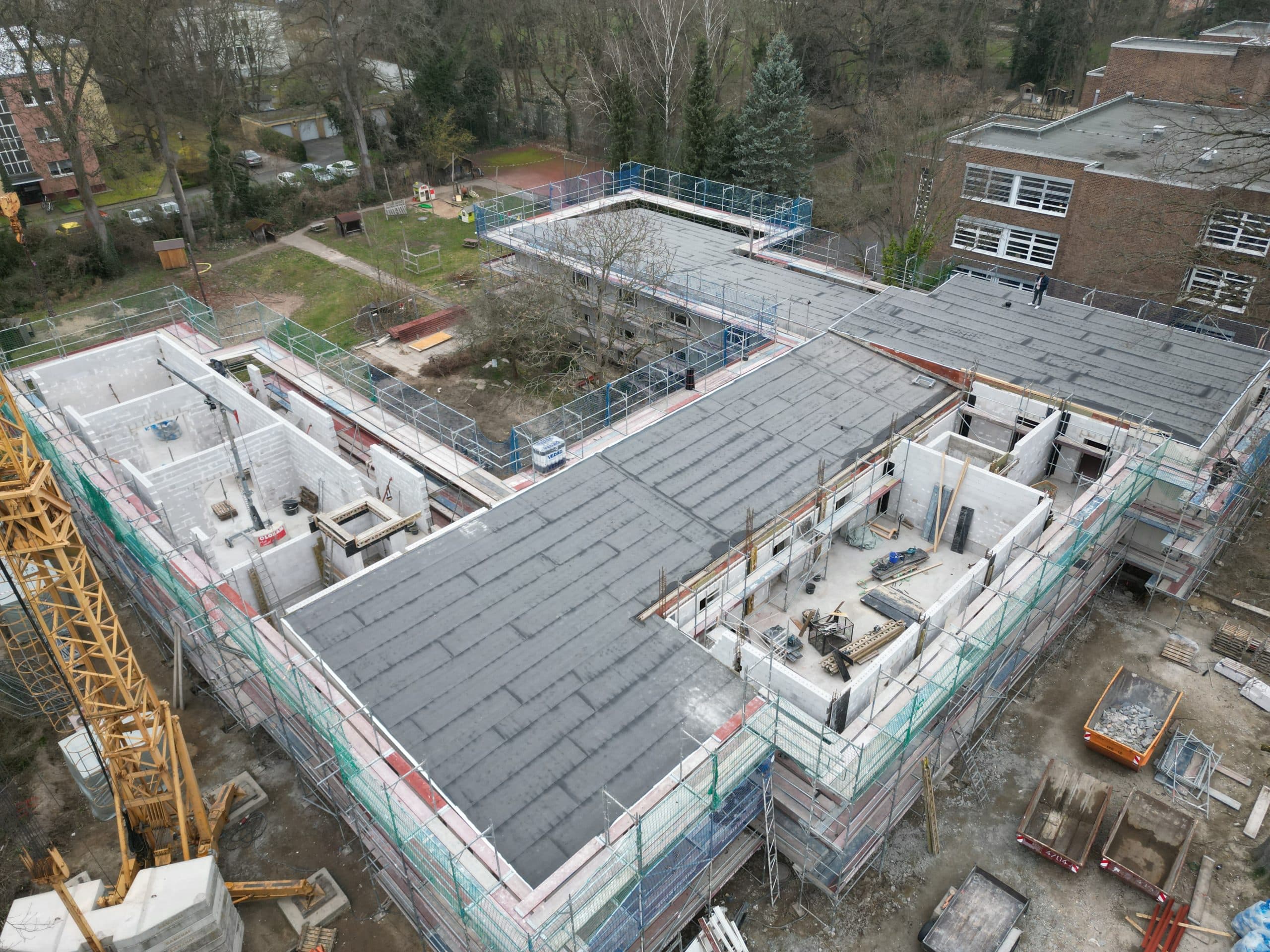
At the Berlin Workshops for People with Disabilities we added two extensions to the existing structure in 2025 and fully gutted the existing building. The roofs were rebuilt and the facade brought up to the current energy standard.
A complete gutting within an existing building is the extreme case of this task. Stripping it back to the structure produces noise, dust and rubble, and yet the adjoining areas and the structural stability have to stay under control at all times. Exactly this combination of demolition, shell construction and extension onto an existing building is what defines a conversion in operation.
How we plan your conversion
It starts with the weak-point analysis: we look on site at which work disturbs the business, where dust and noise arise and which interventions in the structure are due. From that we build a binding construction schedule with the time windows for the loud trades and the coordination with authorities and utility providers.
If you are converting and the business is meant to keep running, we assess in a free initial consultation how to reconcile the two. Get in touch via the contact page or call us on +49 3375 95 09 70.