

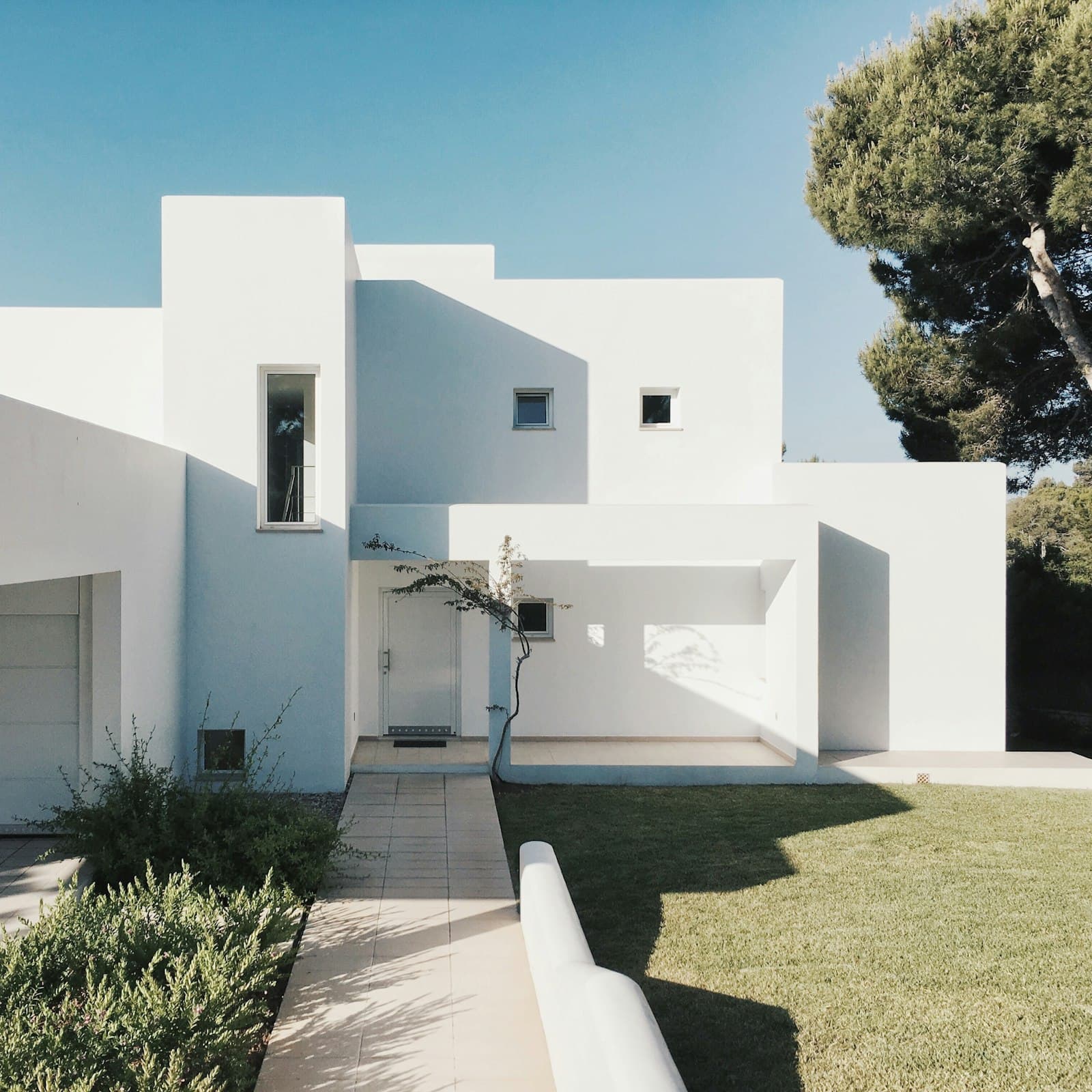
Efficiency House 40 is the standard that decides KfW new-build funding in 2026. Programmes 297, 298 and 300 only pay out if your new build reaches it. Without the standard, there is no low-interest loan.
What lies behind the number 40, and what it means for insulation, windows and building services, is settled during planning. The figures below are current as of July 2026.
What Efficiency House 40 means
Efficiency House 40 means your new build uses only 40 percent of the primary energy of a statutory reference building of the same size and geometry. The lower the number, the better the standard. An Efficiency House 55 would sit at 55 percent, so EH40 is noticeably more economical.
Two values determine the classification: the primary energy demand and the heat loss through the building envelope. The second value describes how much heat escapes through walls, roof, windows and floor slab. Together they must reach the 40 percent mark.
For programmes 297 and 298 (Climate-Friendly New Build), a life-cycle climate assessment is added. It also evaluates the CO2 emissions from the manufacture and construction of the building materials, not just the later operation.
Why EH40 is the key to KfW funding
All three KfW new-build programmes require Efficiency House 40. Without this standard, no application goes through. 297 is aimed at private individuals, 298 at companies, both with a loan of up to €100,000 per residential unit. 300 is reserved for families with at least one minor child and additionally requires the QNG seal. We break down the differences between the three programmes in our article on KfW funding for new builds in 2026.
Since 2 March 2026, programmes 297 and 298 also offer an Efficiency House 55 tier that starts at around 1.0 percent interest. EH40 sits at about 0.6 percent (10-year fixed term). KfW pays no repayment grant for new builds, so the benefit lies solely in the low interest rate over the term.
What Efficiency House 40 requires in construction
No single component reaches the 40 percent mark on its own. It comes from the interplay of the building envelope and the building services. These components work together:
- Insulation: continuous, low-thermal-bridge insulation of floor slab, external walls and roof, considerably thicker than the statutory minimum requires.
- Windows: triple glazing with a low U-value and insulated frames, cleanly integrated into the insulation layer.
- Airtightness: a continuous airtight layer whose tightness is measured with a blower-door test.
- Thermal bridges: planned connection details at the floor slab, window reveals and balconies so no heat drains away at these points.
- Ventilation with heat recovery: a controlled domestic ventilation system that draws the heat from the exhaust air and passes it to the supply air.
- Heat pump: a heat pump as the heating system, which turns one kilowatt-hour of electricity into several times as much heating energy.
These points depend on each other. Strong insulation without tight connections achieves little, and ventilation with heat recovery only pays off in an airtight envelope. That is why the certificate has to be in place before the first spade goes into the ground.
Efficiency House 40 or EH40 plus QNG
The QNG seal (Quality Seal for Sustainable Buildings) raises the loan limit. It requires an independent certification that examines sustainability, materials and planning quality. Whether the effort pays off depends on the number of residential units.
| Feature | Efficiency House 40 | Efficiency House 40 plus QNG |
|---|---|---|
| Requirement | primary energy demand 40 %, life-cycle climate assessment | additionally QNG certification by an independent body |
| Loan limit KfW 297/298 | up to €100,000 per residential unit | up to €150,000 per residential unit |
For a single-family house with one residential unit, the certification effort is offset by €50,000 of extra loan headroom. For an apartment building with four residential units, the difference adds up to as much as €200,000. For programme 300, QNG is mandatory anyway, so the question does not arise there.
The energy efficiency expert is mandatory
For every KfW Efficiency House you need an energy efficiency expert from the federal government's official expert list. They calculate the certificate, confirm the Efficiency House standard to KfW and accompany the construction. Without this confirmation, KfW pays out no Efficiency House loan.
The expert sets the insulation thicknesses, the window quality and the building services early on so the calculation works out in the end. If the Efficiency House standard is only recalculated after the shell is built, corrections become expensive or no longer possible at all.
We factor the Efficiency House requirements into turnkey new builds from the first sketch. Our own engineers calculate the certificate and coordinate it with the detailed design instead of passing it on to third parties. For the detached house with office extension by Gabrys Architektur we handled the shell, the carpentry and the facade, the very components where an Efficiency House has to be tight.
The building services of an economical building often include a photovoltaic system. For the turnkey office and staff building of the Diebel haulage company in Wustermark we fitted the flat roof with a large solar array that is part of the energy concept.
Putting the extra costs in perspective
Efficiency House 40 costs more to build than the statutory minimum standard. Thicker insulation, triple-glazed windows, a ventilation system and a heat pump make themselves felt in the shell and the fit-out. Specific surcharges depend heavily on floor plan, plot and specification, so blanket percentages are misleading here.
Against this stand the low-interest KfW loan over the entire term, the lower running costs from the low energy demand and the better value retention of an economical new build. Whether the calculation works out for your project can only be judged with reliable figures from the planning stage.
How to plan Efficiency House 40 from the start
The first step is to clarify which Efficiency House standard suits your project and budget and whether the QNG seal pays off for you. In a free initial consultation we go through your building project, the Efficiency House certificate and the funding programmes that fit. Bring the rough living area and the number of planned residential units, and the realistic loan limit can be gauged quickly. How we plan and build turnkey is shown on our services page, an overview of all programmes is on the funding page, and you arrange an appointment through the contact form or by phone on +49 3375 95 09 70.